A ‘new normal' for hearing healthcare
When Coronavirus (COVID-19) first surfaced in 2019, we had little idea that it would become a global pandemic. Spreading to almost every country around the world, disrupting daily lives and derailing global economies. The health care and occupational health communities are amongst those that have been the most impacted. But one clear outcome for everyone, is that good hygiene practices are more fundamental than ever.
Proficient health care services and over the counter medicines have made it possible to navigate relatively care-free in a world that is loaded with microorganisms. But the pandemic brought into focus how susceptible we all are to infection and how much bacteria surrounds us every day. To reinforce this message:
A teaspoon of soil contains as many microorganisms as humans currently living in Africa. And a gram of dental plaque contains approximately 1x10¹¹ bacteria. This is roughly the number of humans who ever lived.1
Before the COVID-19 pandemic, healthcare professionals practiced good hygiene as part of standard work. They disinfected work surfaces, wiped down medical equipment, and washed their hands. Fast forward to today, these actions are essential for everyone. They help protect patients, colleagues, and our own families.
According to the Centers for Disease Control and Prevention (CDC) guidelines, audiological services pose a medium to high-risk infection environment for Coronavirus disease because of the proximity to patients, test set-up, and length of appointments.2
Despite the development of several vaccines, the healthcare sector is likely to continue facing some level of strain. This is predominantly due to the ease of virus transmission. As a result, strict hygiene, sanitation programmes and other preventive measures will remain an ongoing requirement to help reduce exposure and support effective disease control and prevention.
A ‘high-touch’ service
Traditionally, audiological care has been very much a ‘high-touch’ service. Equipment is frequently handled through many face-to-face screening assessments, hearing-aid fittings and follow-up appointments. All conducted within confined spaces.
Most people who need audiology services are also over 70 years old.3 This age group is considered high risk for Coronavirus complications, particularly where underlying health problems or another recognised risk factor are present.
The potential for future physical distancing restrictions, increased sanitation, ventilation and lockdowns also creates challenging circumstances when providing a high-quality hearing health service. The question is; do hearing healthcare services need to adapt to additional hygiene practices. And if so, how do we tackle this?
Adapting to a new normal
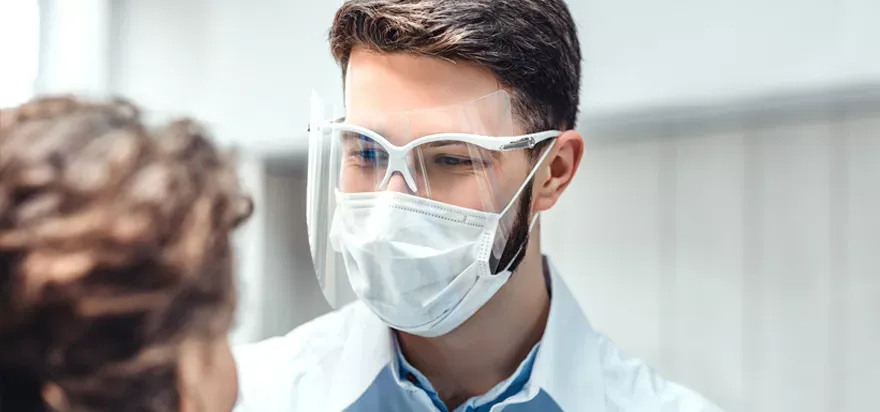
Occupational health professionals, audiologists and clinicians now have to reconcile with the fact that social distancing restrictions of some degree is now a ‘new normal’. They must therefore adapt accordingly with patient safety being top-of-mind, along with increased use of PPE.
A digital approach
With an occupational hazard such as Coronavirus, elimination is impossible, so it becomes about minimising risk and reducing each avoidable risk factor. A digital approach should be considered first, whereby patient interactions can be conducted via phone, video, email, or any other form of digital communication as appropriate.
Where face-to-face appointments are needed, clinics and procedures must meet required standards. Staff should use professional judgement on need and follow local policy.
Before conducting any clinics, practitioners should make sure they are fully competent with basic sterilisation techniques, hygiene principles and preventive measures. Hand and respiratory hygiene should be in place, as well as allocation of time for deep cleaning areas that provide the space to social distance.
Air supply and ventilation
There may also need to be a consideration of the air supply to the facility. Most types of air conditioning systems can be used as normal. But if there’s a centralised ventilation system which removes and circulates air to different rooms, it’s recommended to turn it off and use a fresh air supply.
Surgical masks
As well as this, if using a fluid resistant surgical mask (FRSM type IIR) for a continued period (more than one patient visit), it should not be removed or touched until the usage period is concluded. Masks should be replaced as soon as they become damaged, cause skin irritation, or become difficult to breathe through.
Hygiene consumables to help minimise risk
Hygiene rules within the medical sphere have consistently been very strict, as we have always been aware contamination and cross-infection risks.
However, Coronavirus or any another viral respiratory disease is likely to continue as a pervasive global influence. While it poses a tremendous challenge to traditional audiological services, it also creates the incentive to rapidly adapt to a changing landscape.
For more information on hygiene consumables please contact our customer support team on +44 (0)1698 208216 or email.